
Why Small VCs Sometimes Outperform Big VCs
Smaller venture funds quietly post some of the strongest returns in the asset class. Here's what the data shows, why it happens, and what LPs, founders, and emerging managers should take from it.
Key Takeaways
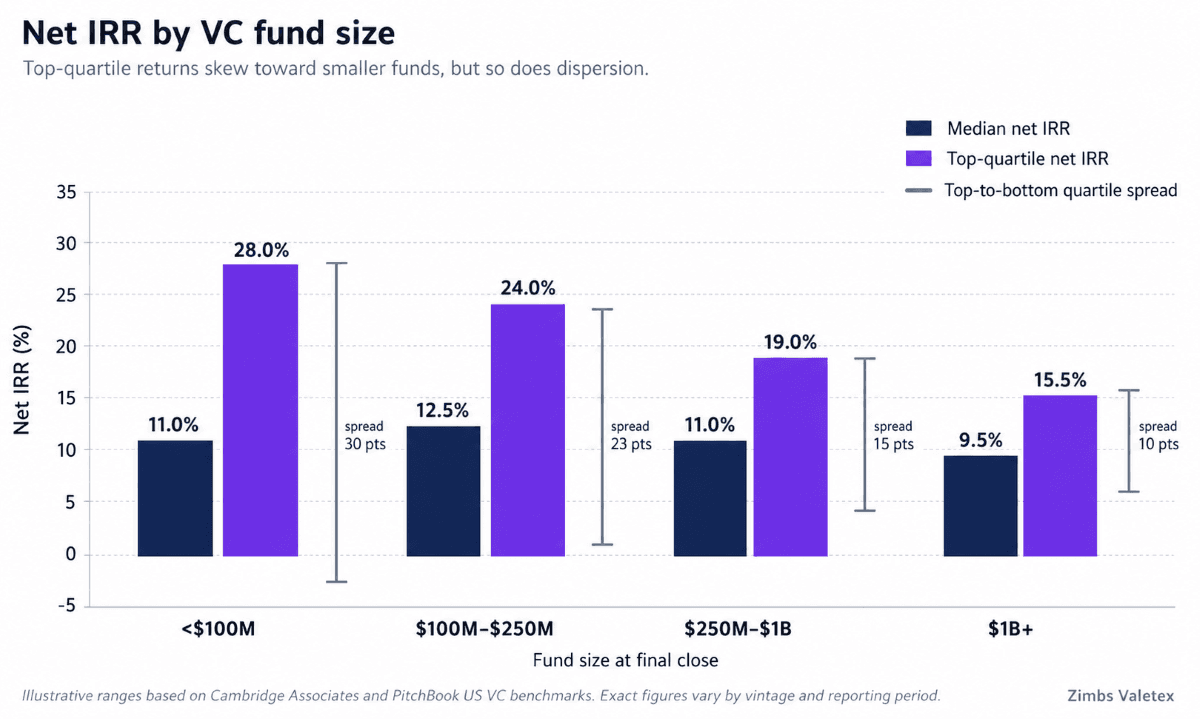
- check_circleTop-quartile returns in venture capital skew toward smaller funds, but so does the dispersion — the gap between the best and worst small funds is wider than for large funds.
- check_circleSmaller funds benefit from return math: a single strong exit can move a $100M fund meaningfully, but barely registers on a multi-billion-dollar fund.
- check_circleLarger funds win on capital reserves, brand signaling, and the ability to support a company through multiple rounds without dilution from outside leads.
- check_circleFor LPs, the real edge is manager selection. The dispersion in small funds means picking well matters more than picking small.
- check_circleFor founders, fit between fund size and stage often predicts engagement more reliably than the fund's logo.
The quiet outperformance of small funds
If you only read the trade press, you would assume venture capital returns flow to the largest names. The reality is messier. Year after year, when researchers slice fund-level performance data by size, smaller funds quietly produce some of the strongest returns in the asset class. Not always. Not on average across every vintage. But often enough that LPs who write the largest checks have spent the last decade building dedicated emerging-manager programs to capture it.
This post is not a pitch for small funds. It is an attempt to lay out, honestly, why the structure of a smaller venture fund creates real return advantages, where the obvious counter-arguments hold up, and what each side of the table — LPs, founders, and emerging managers — should actually take from the data.

What the data actually says
Two long-running data series shape this conversation: Cambridge Associates' US Venture Capital Index and PitchBook's quarterly benchmarks. Neither is perfect. Both have survivorship bias. Both rely on GP-reported NAVs, which lag and smooth real performance. With those caveats taken seriously, the patterns are still consistent enough to draw a few honest conclusions.
- Top-quartile IRR is generally higher for sub-$250M funds than for funds above $1B, across most measured vintages.
- Median returns are closer than top-quartile returns. The advantage of smaller funds is concentrated in the upper end of the distribution.
- Dispersion — the gap between top-quartile and bottom-quartile — is materially wider for smaller funds. The best are very good, the worst are very bad.
- Vintage matters. In hot vintages where capital flooded the asset class, larger funds caught a larger share of that capital and the dispersion gap narrowed.
Why smaller funds can outperform
Five structural features explain most of the advantage. None of them require a small fund to be smarter than a large one. They are mechanical, and they compound.
1. Return math
This is the most cited reason and also the most quantitatively real. Consider a $100M fund that holds a 10% stake in a portfolio company that exits for $500M. That single exit returns half the fund. The same exit from a 1% stake in a $3B fund returns less than two percent of the fund. Big funds need either much larger exits or much higher ownership at exit, and both are difficult.
A small fund needs one good outcome to be a great fund. A big fund needs several enormous outcomes to be a good fund.
2. Access to early-stage deals
The largest funds cannot meaningfully deploy at the seed and pre-seed stages. A $3B fund writing $1M checks would need to build a portfolio of three thousand companies just to invest the fund, which is operationally absurd. Smaller funds get to price and lead at stages where the largest names are forced to be passive co-investors or pass entirely.
Early-stage entry points are also where the most extreme outcomes are seeded. The companies that eventually become category-defining were almost always priced cheaply at the start. Small funds get the entry price, large funds usually pay up later for the same exposure.
3. Attention per company
A partner with five active board seats engages differently from a partner with fifteen. Small funds, by structure, force fewer commitments per partner. That sharper attention shows up in how fast a portfolio company can get a recruiting introduction, a strategic intro to a customer, or honest pushback on a fundraise plan. None of this is heroic on its own, and the largest funds have platform teams that compensate. But the relationship between an investor and a founder is still ultimately a one-to-one thing.
4. GP economics and skin in the game
Most small-fund GPs make their real money on carry, not on management fees. A $100M fund paying 2% generates $2M annually across, often, two or three partners. That is a salary, not a retirement plan. The path to wealth is through fund returns, which keeps the incentive sharply aligned with the LP.
At multi-billion-dollar AUM, management fees alone become career-changing. The risk for LPs is not malice, just gravity. When fees are large, the cost of a mediocre fund to the GP is lower, and the urgency on returns softens.
5. Flexibility on unconventional founders
Large funds have committees, portfolio construction rules, and brand risk to manage. Small funds have a partnership of one to four people who can decide on a non-obvious founder over a weekend. That flexibility is not always an advantage — sometimes the committee is right and the small fund is wrong. But the funds that consistently back unusual founders with unusual theses tend to be small, and that is where the asymmetric outcomes have historically lived.
Where big funds genuinely win
It would be a flat piece if it stopped here. The structural advantages of large funds are real and matter at specific stages of a company's life.

- Reserve capital for follow-ons. A large fund can lead the seed, the Series A, the Series B, and the Series C without ever needing the company to bring in an outside lead. That continuity protects ownership and signals strength to later investors.
- Brand signaling. The logo of a top-five firm on a pitch deck still moves recruiting, BD intros, and follow-on demand in ways smaller fund logos do not.
- Multi-stage support. Late-stage operating, growth, and IPO experience usually lives at the larger firms. A founder at Series C wants someone who has done that ten times before.
- Capacity to lead large rounds. When a company needs $50M or $100M in a single round, only a handful of firms can write that check at the necessary ownership.
Most successful companies end up with both kinds of investors over time, and that is the right answer for most cap tables. The argument is not small versus large in absolute terms. It is which fund matters most at which stage, and where the structural advantages of small funds get under-appreciated by LPs who anchor on AUM.
What this means for each side of the table
For LPs
The wider dispersion in small funds is the central fact. It means the LP who can identify a top-quartile small fund earns more than they would by picking a top-quartile large fund, and the LP who picks badly loses more decisively. Manager selection is doing more work in this segment than in any other part of the venture market. That is also why most institutional LPs cannot allocate aggressively to micro funds — the diligence cost per dollar deployed is too high to make it worth their time, which is precisely the inefficiency that smaller LPs and family offices can exploit.
For founders
Fund size and stage fit usually predicts engagement better than fund brand. A pre-seed founder taking a small check from a multi-stage giant is, by the math of that fund, a side bet. The same founder with a $80M fund where they are a top-five priority gets a different relationship. Brand is real and worth paying for, but it should be paid for with eyes open about what comes with it.
For emerging managers
The structural advantages above are gifts of fund design. Capturing them takes discipline. Hold fund size below the level where return math stops working. Resist the temptation to expand check sizes faster than ownership stakes can keep up. Run a clean cap table on the GP entity, document portfolio decisions properly, and treat 409A and ASC 820 obligations with the same seriousness a $1B fund would. The advantages of being small disappear quickly when operations get sloppy at the GP level.
The honest caveats
- Survivorship bias is real. Funds that fail to raise a follow-on fund frequently stop reporting, which lifts the apparent performance of the surviving small-fund cohort.
- NAVs are GP-reported and lag. Realized DPI, not paper IRR, is the better lens, and the gap between the two has been larger for vintages 2018 to 2022 than at any point in the last twenty years.
- Top-quartile is not median. The argument is about the upper tail of the distribution, not the average small fund.
- Selection is hard. The same dispersion that creates the upside also punishes naïve allocation.
None of these caveats overturn the case. They sharpen it. Small-fund outperformance is a story about distributions, not averages, and about discipline, not size for its own sake.
Closing
The interesting question is not whether small funds beat large funds. It is why the structural features of a small fund tilt the upper tail of returns, and how to take that seriously without being naïve about the risk that sits underneath the same distribution. For the LPs and emerging managers who get this right, the math has been kind for a long time.
Frequently Asked Questions
Do small VC funds really outperform large ones?expand_more
On average, smaller venture funds tend to post higher top-quartile IRRs than large funds, based on widely cited data from Cambridge Associates and PitchBook. The catch is dispersion. The best small funds beat the best large funds, but the worst small funds also lose more decisively, so the average alone hides the real story.
Why do smaller funds have a structural advantage?expand_more
Three reasons stand out. First, return math — a $50M to $100M exit can return a small fund, but barely moves a multi-billion-dollar fund. Second, access — small funds can write seed and pre-seed checks where the largest funds cannot deploy at scale. Third, focus — fewer companies per partner usually means sharper attention and better company support.
What advantages do large VC funds have?expand_more
Large funds have meaningful reserve capital for follow-ons, established brand signaling that helps portfolio companies recruit and raise, and the staffing depth to support multi-stage growth. They also have access to later-stage rounds where smaller funds get crowded out.
What does this mean for an LP picking funds?expand_more
Selection matters more than size. Because dispersion is wider in the small-fund segment, an LP who picks well in that segment can earn outsized returns, while a poor pick can underperform sharply. LPs should weight manager track record, sourcing edge, and discipline over the simple heuristic of going small or going large.
Should founders prefer a small or large VC?expand_more
Match fund size to stage and check size, not brand. A pre-seed founder taking a check from a $3 billion fund is often someone else's experiment, while the same founder with a $100M fund may be a top-five priority for their lead partner. At later stages the calculus reverses, and the depth and reserves of large funds become more valuable.
Run audit-ready valuations in one platform
DCF, GPC, backsolve, OPM/CVM, cap tables, built for CPA firms and valuation advisors. See a walkthrough tailored to your practice.