The Real Role of CapIQ in Building Accurate Business Valuations
Discover how S&P Capital IQ powers business valuations with verified financial data, comparable company analysis, and M&A benchmarks — all in one platform.

Key Takeaways
- check_circleS&P Capital IQ acts as a central hub for company financials, industry data, market trends, and M&A transactions — eliminating hours of manual data collection.
- check_circleData quality directly impacts valuation accuracy; CapIQ provides standardized, verified financial data across 500K+ companies.
- check_circleCapIQ makes comparable company analysis practical by filtering by industry, geography, and size to calculate multiples like EV/EBITDA.
- check_circleStartups preparing for funding can use CapIQ data to benchmark against real market comparables and add credibility to their valuation.
- check_circleWithout structured data platforms, valuation teams rely on scattered sources — leading to inaccurate results and time-consuming workflows.
When someone talks about valuing a company, the first question that comes to mind is — where does all the data come from? Valuation is not just about formulas or financial models; it heavily depends on the quality of data being used. Many businesses struggle not because they don't understand valuation, but because they don't have access to structured and reliable financial information. This is exactly where tools like S&P Capital IQ (CapIQ) become important.
What Makes CapIQ So Useful?
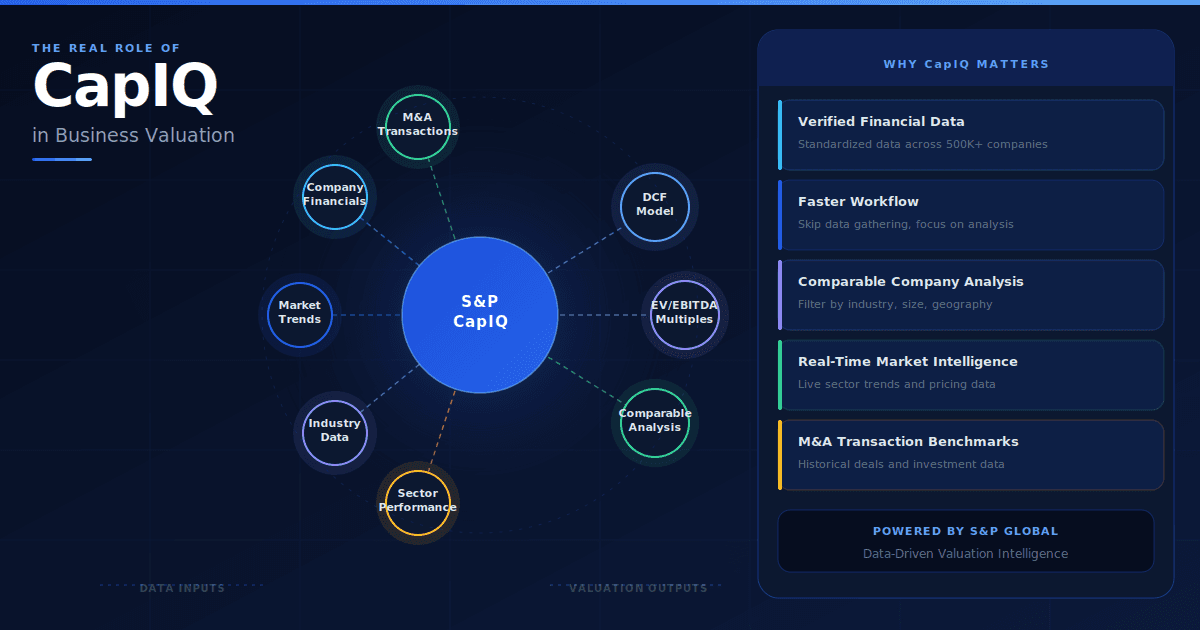
S&P Capital IQ, developed by S&P Global, is more than just a financial database. It acts like a central hub where you can find company financials, industry data, market trends, and even past transactions — all in one place. Instead of spending hours collecting data from different sources, analysts can directly access well-structured information and focus on actual decision-making.
Why CapIQ Matters in Valuation
Data Quality Directly Impacts Valuation
Valuation results are only as good as the data behind them. If the data is incomplete or outdated, the final valuation can be misleading. CapIQ solves this by providing standardized and verified financial data. This ensures that decisions are based on facts, not assumptions.
Saves Time Where It Actually Matters
A lot of time in valuation is wasted in collecting and cleaning data. With CapIQ, most of this work is already done. Users can quickly pull financials, ratios, and company insights. This allows analysts to spend more time understanding the business rather than just preparing data.
Makes Comparable Analysis Practical
Finding the right comparable companies manually is not easy. CapIQ simplifies this process by allowing users to filter companies based on industry, geography, size, and financial metrics. This makes it easier to calculate valuation multiples like EV/EBITDA or P/E and arrive at a more realistic estimate.
Helps Understand Market Behavior
Valuation is not done in isolation — it is influenced by market conditions. CapIQ provides access to industry trends and sector performance, helping users understand how similar companies are behaving. This context is crucial for making better valuation judgments.
Useful for Transaction-Based Insights
Another important aspect of valuation is understanding past deals. CapIQ includes data on mergers, acquisitions, and investments, which can be used as benchmarks. This helps businesses and investors understand what the market is willing to pay.
Supporting Financial Models
Whether it is a Discounted Cash Flow (DCF) model or any other valuation approach, having clean and structured data makes a huge difference. CapIQ allows easy data extraction, which can be directly used in financial models. This reduces manual errors and improves overall efficiency.
Why It's Relevant Beyond Big Corporates
CapIQ is often associated with investment banks and large firms, but its value is not limited to them. Startups and growing businesses can also benefit from it. For example, a startup preparing for funding can use CapIQ data to compare itself with similar companies and justify its valuation. It adds credibility when founders can back their numbers with real market data.
What Happens Without Tools Like CapIQ?
Without access to structured platforms, valuation becomes more difficult and less reliable. Teams often depend on scattered data sources, manual calculations, and assumptions.
- Inaccurate valuation
- Missed market insights
- Time-consuming workflows
Moving Towards Data-Driven Valuation
The way businesses approach valuation is clearly shifting. Instead of relying only on intuition or limited data, companies are now using data platforms to support their analysis. CapIQ is one of the tools that enables this shift by making high-quality financial data easily accessible.
Conclusion
At its core, valuation is about understanding a company's true worth. But that understanding depends heavily on the data you use and how efficiently you can analyze it. CapIQ helps bridge that gap by providing reliable data, saving time, and improving the overall quality of analysis.
For anyone involved in valuation — whether an investor, analyst, or business owner — it becomes a valuable part of the process.
Frequently Asked Questions
What is S&P Capital IQ (CapIQ)?expand_more
S&P Capital IQ, commonly called CapIQ, is a financial data and analytics platform developed by S&P Global. It provides access to company financials, industry data, market trends, M&A transactions, and valuation multiples across 500K+ companies globally. It is widely used by investment banks, private equity firms, and valuation analysts.
How does CapIQ help in business valuation?expand_more
CapIQ supports valuation by providing clean, standardized financial data that feeds directly into valuation models like DCF, GPC comparable analysis, and M&A benchmarking. Instead of spending hours gathering and cleaning data from multiple sources, analysts can pull verified financials, sector trends, and transaction data in one place — improving both speed and accuracy.
Can startups use CapIQ for their valuation?expand_more
Yes. While CapIQ is commonly associated with large institutions, startups preparing for funding rounds can use comparable company data from CapIQ to benchmark their valuation against similar businesses. Backing a valuation with real market data from a credible platform significantly strengthens a founder's position in investor discussions.
What valuation multiples does CapIQ provide?expand_more
CapIQ provides a wide range of valuation multiples including EV/EBITDA, EV/Revenue, P/E, and Price/Book across industries and geographies. These multiples can be filtered by company size, sector, and time period to build a relevant set of comparables for any valuation analysis.
What happens if you do a valuation without structured data platforms like CapIQ?expand_more
Without structured platforms, valuation teams rely on scattered public sources, manual data collection, and unverified assumptions. This leads to inaccurate valuations, missed market insights, and significantly slower workflows. The risk of errors increases substantially when data cannot be verified or standardized across sources.
Run audit-ready valuations in one platform
DCF, GPC, backsolve, OPM/CVM, cap tables, built for CPA firms and valuation advisors. See a walkthrough tailored to your practice.