
Startup Valuation Methods Explained: Backsolve, GPC, M&A & Post-Money
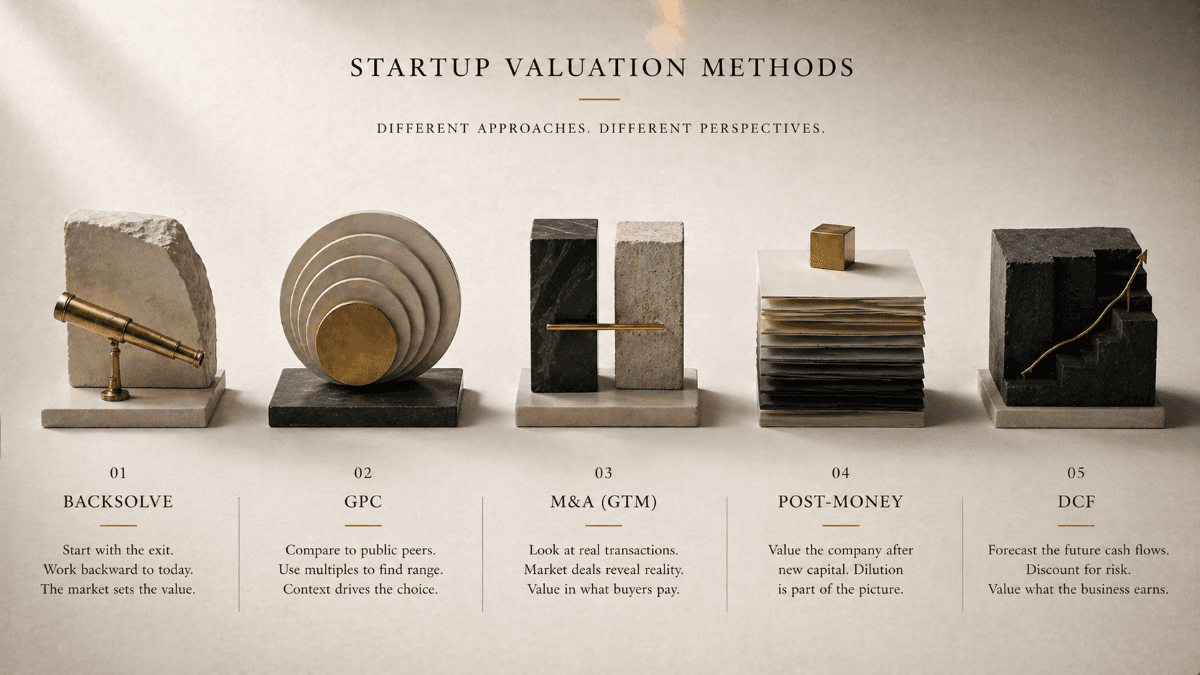
Learn the four most commonly used startup valuation methods — Backsolve, GPC, M&A, and Post-Money. Understand how each works, when to use it, and its trade-offs for fundraising and 409A compliance.
Key Takeaways
- check_circleThe Backsolve Method uses recent funding round prices to work backward and estimate total company value — best for 409A valuations.
- check_circleThe GPC Method compares a startup with similar public companies using valuation multiples like EV/Revenue or EV/EBITDA.
- check_circleThe M&A Method estimates value based on what buyers actually paid for similar companies in past acquisition deals.
- check_circleThe Post-Money Method is the simplest approach: investment amount divided by ownership percentage gives company valuation.
- check_circleMost reliable valuations combine multiple methods — no single approach fits every stage or situation.
Introduction
Valuing a startup is one of the most important decisions in the business and investment world. Unlike established companies, startups often have limited financial history, uncertain growth, and evolving business models. Because of this, traditional valuation methods are not always suitable.
In the startup ecosystem, valuation plays a key role in fundraising, ownership distribution, and investor decision-making. Different methods are used depending on the stage of the company and the availability of data.
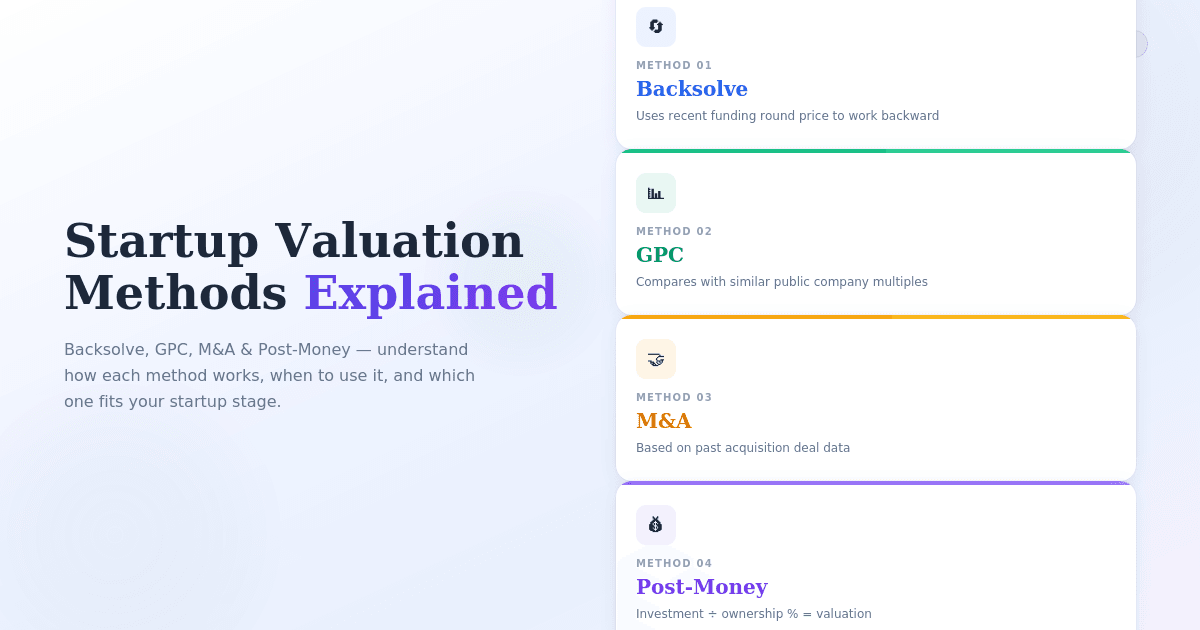
The four most commonly used startup valuation methods are:
- Backsolve Method
- Guideline Public Company (GPC) Method
- M&A Method (Mergers & Acquisitions)
- Post-Money Valuation Method
Backsolve Method
The Backsolve Method is a popular way to find a startup's value. It uses the price that investors paid in a recent funding round to estimate the total company value. In simple words, we use the investor's share price to calculate the company's value by working backward.
How It Works
- Investors buy shares (usually preferred shares) at a fixed price
- That price shows what investors think the company is worth
- A valuation model (like OPM) is used to divide the value among all shareholders
- The model works backward to calculate the total company value
When to Use It
- Startups with a recent funding round (Series A, B, etc.)
- 409A valuation for employee stock options
- Financial reporting and audits
| Advantages | Limitations |
|---|---|
| Based on real investor transactions | Needs a recent funding round |
| Trusted by investors and auditors | Value can become outdated over time |
| Reflects actual market value | Assumes the investor paid a fair price |
GPC Method (Guideline Public Company)
The GPC Method is used to find a startup's value by comparing it with similar public companies. We look at how similar listed companies are valued and apply that to our startup.
How It Works
- Find public companies in the same industry
- Look at their valuation multiples like Revenue multiple (EV/Revenue) and Profit multiple (EV/EBITDA)
- Apply these multiples to your startup's numbers
When to Use It
- Late-stage startups
- Companies with stable or growing revenue
- Market comparison and benchmarking
| Advantages | Limitations |
|---|---|
| Based on real market data | Hard to find truly similar companies |
| Easy to understand and explain | Public companies are usually less risky than startups |
| Useful for investor presentations | Not suitable for early-stage startups |
M&A Method (Mergers & Acquisitions)
The M&A Method is used to find a company's value based on past deals where similar companies were bought or sold. We look at how much buyers paid for similar companies and use that to estimate our value.
How It Works
- Find companies in the same industry that were recently acquired
- Check their valuation multiples (like Revenue multiple)
- Apply those multiples to your company's numbers
When to Use It
- Exit planning (when you want to sell your company)
- Strategic acquisitions
- Investment banking analysis
| Advantages | Limitations |
|---|---|
| Based on real market deals | Hard to find reliable deal data |
| Shows what buyers are actually willing to pay | Deal prices may be higher due to strategic value |
| Useful for estimating exit value | Market conditions can change over time |
Post-Money Valuation Method
The Post-Money Valuation Method is the simplest way to calculate a startup's value during fundraising. We use the investment amount and ownership percentage to find the company's value after funding.
How It Works
- An investor invests money in the company
- In return, the investor gets a percentage of ownership
- Using this, we calculate the total company value
When to Use It
- Venture capital funding rounds
- Cap table updates
- Ownership calculations
| Advantages | Limitations |
|---|---|
| Very simple and quick | Does not consider company performance |
| Easy to understand | Ignores risk and future dilution |
| Commonly used in funding deals | Not suitable for detailed financial reporting |
Comparison of All Four Methods
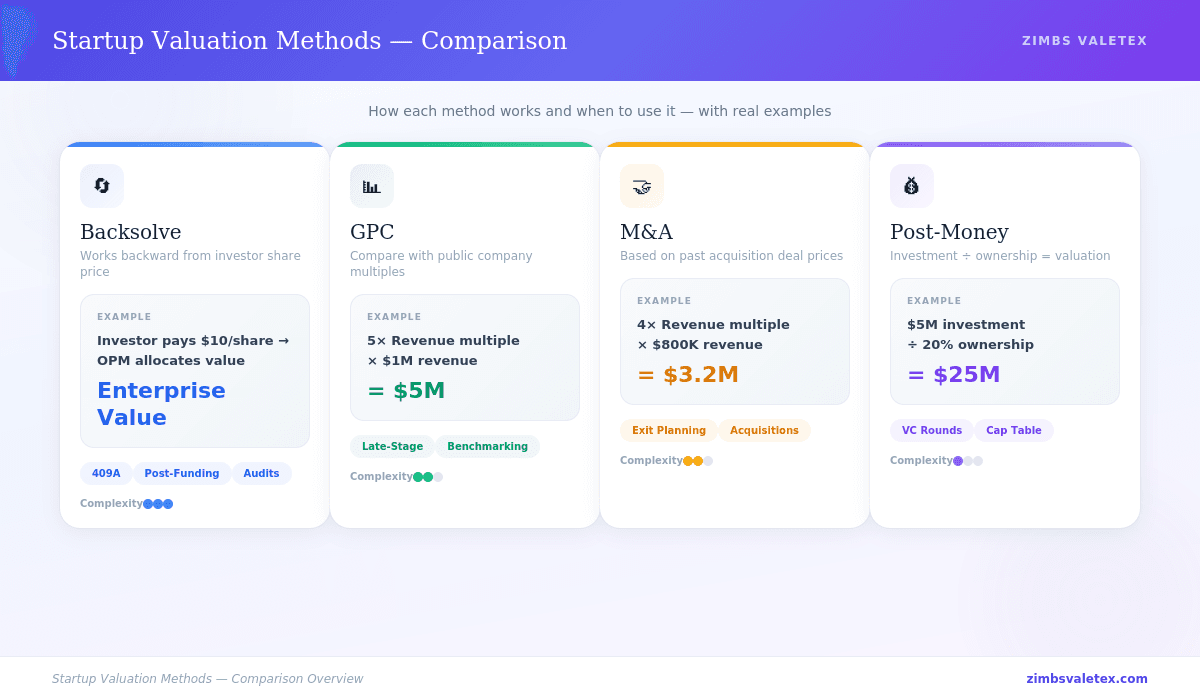
| Method | Best For | Data Source | Complexity |
|---|---|---|---|
| Backsolve | Post-funding 409A valuations | Recent funding round price | High |
| GPC | Late-stage with revenue | Public company multiples | Medium |
| M&A | Exit planning and acquisitions | Past acquisition deals | Medium |
| Post-Money | Quick fundraising valuation | Investment terms | Low |
Conclusion
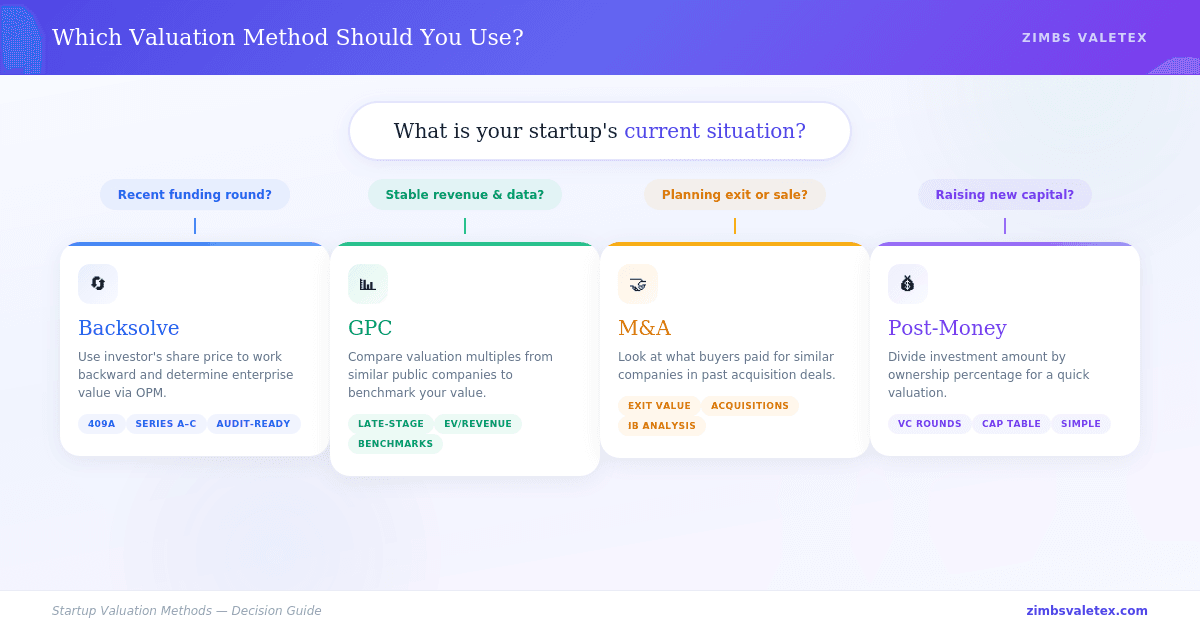
There is no single best method for startup valuation. Each method serves a different purpose depending on the situation:
- The Backsolve Method is best when recent funding data is available
- The GPC Method works well for companies with stable revenue and market comparables
- The M&A Method is useful for estimating exit value
- The Post-Money Method is ideal for quick valuation during fundraising
A modern valuation platform can help companies apply the right method at the right time, ensuring accurate, compliant, and investor-ready valuations.
Frequently Asked Questions
What are the most common startup valuation methods?expand_more
The four most commonly used startup valuation methods are the Backsolve Method (using recent funding round data), Guideline Public Company (GPC) Method (comparing with similar public companies), M&A Method (based on past acquisition deals), and Post-Money Valuation Method (using investment amount and ownership percentage).
What is the Backsolve Method in startup valuation?expand_more
The Backsolve Method uses the price investors paid in a recent funding round to estimate the total company value. It works backward from the investor's share price using a valuation model like the Option Pricing Model (OPM) to allocate value across all share classes including preferred shares, common shares, and stock options.
How does the GPC Method work for startup valuation?expand_more
The GPC (Guideline Public Company) Method values a startup by comparing it with similar publicly listed companies. It uses valuation multiples such as EV/Revenue or EV/EBITDA from comparable public companies and applies those multiples to the startup's financial metrics to estimate its value.
When should I use the Post-Money Valuation Method?expand_more
The Post-Money Valuation Method is ideal for quick valuation during venture capital funding rounds. It calculates the company's value after funding by dividing the investment amount by the ownership percentage the investor receives. For example, a $5M investment for 20% ownership gives a $25M post-money valuation.
Which startup valuation method is best for 409A compliance?expand_more
The Backsolve Method is commonly used for 409A valuations because it is based on real investor transactions from recent funding rounds. It provides a defensible and auditable basis for determining the fair market value of common stock for employee stock option pricing.
Run audit-ready valuations in one platform
DCF, GPC, backsolve, OPM/CVM, cap tables, built for CPA firms and valuation advisors. See a walkthrough tailored to your practice.